Universal Module Engine (UME)
The UME is the shared orchestration foundation. It is designed to assemble authorized capabilities for an organization’s sector, policies and connected systems, while preserving tenant isolation and limiting changes to approved workflows.
Decision Genome
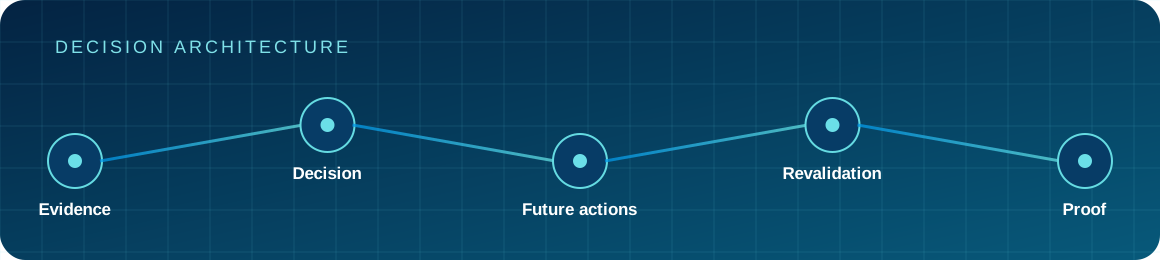
A structured decision record connects source evidence, context, assumptions, alternatives, approvals, risks and actual outcomes. It helps teams explain why an action was proposed and what would require reconsideration.
EFAR
Evidence-Conditioned Future Action Reconciliation examines intended future actions against new evidence, changing conditions and execution constraints. It can flag plans that need review before they become unsafe or outdated.
FEER
FEER addresses decisions already made. When a supporting fact, policy or obligation changes, the architecture is designed to identify affected historical decisions, preserve their original context and open targeted re-evaluation.
QEP
The nine-stage QEP lifecycle—Discover, Assess, Reconstruct, Anticipate, Invent, Protect, Approve & Execute, Prove and Evolve—organizes evidence gathering, decision formation, guarded action and verified learning.
Consequence Firewall & recovery
A proposed action is checked against authority, dependencies and defined risk boundaries. If the observed outcome differs from the approved intent, the platform is designed to retain obligations for targeted repair, escalation and independent closure.