
One platform. Connected intelligence.
A shared operating architecture for evidence, reasoning, controlled action, verification and organizational learning.
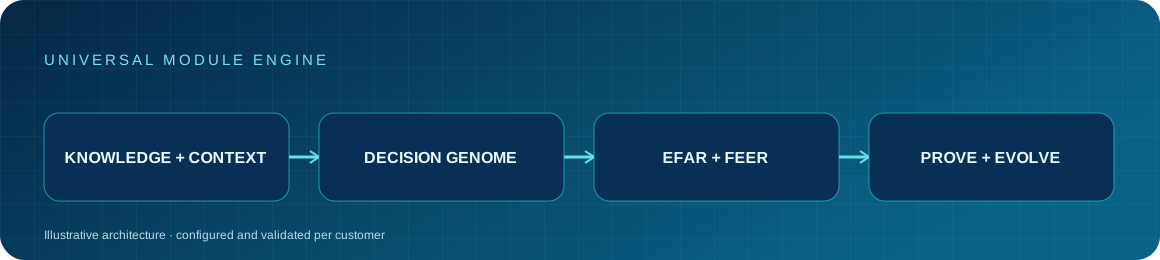
From signals to outcomes
Ceryvra is designed as a coordinated system rather than a collection of disconnected copilots.
Knowledge foundation
A centrally curated, source-backed industry foundation is planned alongside isolated tenant context.
Reasoning & foresight
Use decision context, consequences and uncertainty to propose actionable options.
Authorized execution
Actions are subject to policies, approvals and bounded connector permissions.
Independent proof
Success requires observable evidence beyond an action reporting completion.
Recovery & obligations
Track unresolved failures, required repairs and outstanding evidence.
Verified evolution
Govern how actual outcomes update organizational knowledge.
C‑E‑R‑Y‑V‑R‑A
A customer-facing way to explain the journey from operational signal to verified improvement.
Capture
Gather authorized signals and evidence.
Evaluate
Assess reliability, relevance and constraints.
Reason
Explore scenarios and consequences.
Yield
Form actionable recommendations.
Validate
Check approvals and safety boundaries.
Reconcile
Compare actual results with expectations.
Advance
Preserve verified learning and improve.
Connected, not fragmented
The Universal Module Engine (UME) is the common foundation for composing approved, sector-relevant capabilities. The Decision Genome maintains the evidence, context and authority behind a decision. EFAR—Evidence-Conditioned Future Action Reconciliation—rechecks planned actions as conditions evolve, while FEER revisits earlier decisions when supporting evidence changes. QEP coordinates the full cycle from discovery through independently proven outcomes and governed learning.
Rather than giving an AI system unlimited access, Ceryvra is designed to use tenant-specific permissions, policy checks, execution safeguards and independent verification. Capabilities are being developed and require integration and production validation.