
Most organizations have more data, more software and more AI than ever—yet critical decisions still depend on fragmented evidence, manual coordination and unverified results. Ceryvra is being built to close that gap: connecting insight to responsible action, then proving what changed.
Intelligence That Reasons.
Execution That Adapts.
Outcomes You Can Verify.
Ceryvra unifies evidence, foresight, permissioned execution and independent proof into an accountable operating lifecycle—designed to help organizations move from uncertainty to verified improvement.
One connected QEP lifecycle
Target industry architecture
Evidence to verified outcome
Certainty. Verification. Agility.
Explore how the three disciplines connect through a governed decision core.
System core
Connect evidence, authorized decisions, execution, and independent outcome verification.
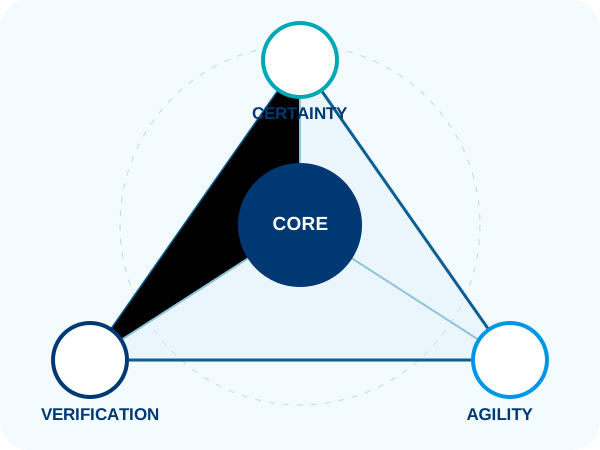
Certainty. Verification. Agility.
Ceryvra brings together three commitments: know the basis for a decision, prove what happened after action, and respond intelligently as circumstances change. These principles inform the architecture of its Decision Genome, QEP, EFAR and independent outcome verification.
Certainty
A trustworthy decision starts with traceable evidence, explicit assumptions and clear decision authority. Ceryvra is designed to connect policies, source records, risk tolerances and unresolved questions so teams can see not only the recommended action but why it is appropriate—and when more information is needed.
Verification
A completed task is not necessarily a successful outcome. Ceryvra separates action from proof: independent observations are compared with the intended result, discrepancies create follow-up obligations, and evidence remains linked to the decision record for review and audit.
Agility
Real organizations face changing staffing, regulations, systems, budgets and unexpected failures. Ceryvra is designed to detect meaningful changes, reassess consequences, present safer alternatives and coordinate authorized recovery without losing the evidence and controls behind the original decision.
Intelligence is only valuable when organizations can act—and verify the result.
Many organizations already have AI assistants, dashboards, workflow tools and policy repositories. The challenge is that evidence, approvals, execution and confirmation are often spread across different systems. Ceryvra's proposed operating layer connects them, helping teams understand a problem, evaluate the consequences of possible actions, obtain appropriate authorization and establish whether the intended outcome actually occurred.
The fragmented approach
A chatbot may explain an incident, a dashboard may show a metric and a ticketing system may track work. Yet staff still need to reconcile competing facts, find the right policy, obtain approvals, coordinate tools and prove that a fix worked. Those handoffs consume time and can obscure accountability.
Existing AI and automation platforms can address parts of this problem; the distinction here is the integrated evidence-to-outcome design.
The Ceryvra approach
The Decision Genome preserves context and rationale. QEP structures discovery through learning. EFAR helps reconcile planned future actions against changing evidence. The Consequence Firewall and delegated permissions constrain execution, while independent verification checks observed results. The organizational memory layer retains governed lessons for subsequent decisions.
The goal is not automation at any cost: it is more consistent judgment, faster coordination, safer action and defensible results.
One connected operating intelligence
From the Decision Genome and QEP to EFAR, FEER and the Universal Module Engine, Ceryvra is designed to preserve the reasoning behind important decisions, coordinate authorized responses and learn from independently checked results. Its aim is not to replace professional judgment, but to make organizational action more informed, controlled and explainable.